Choosing Attachments for Forklifts: Start With the Load and Workflow
Choosing attachments for forklifts begins with a clear picture of what the truck handles each day, not just the maximum weight on a pallet. Consider the load type, material, dimensions, condition and pickup method. Paper rolls, cartons, drums and long lumber loads may need different types of forklift attachments, even at similar weights. From pallet forks and extensions to drum handlers, bale clamps and hydraulic clamps, the right attachment depends on the work at hand and the material handling requirements.
Review the workflow just as carefully. Note where loads start and finish, whether operators need to turn, clamp, side-shift, rotate or reach into storage, and how much clearance is available in aisles, trailers and loading areas. The most handy forklift attachments make a specific task safer, more efficient and more repeatable. They should not require operators to improvise around an unsuitable setup. A side shifter, fork positioner, telescopic boom attachment or other truck attachments can increase control during load handling when matched to the material and operating environment. These six well-designed solutions should support the task, not complicate it.
Capacity is central to every decision. Attachment weight reduces the lifting capacity of forklifts, and a forklift attachment may position the load farther forward, changing the truck’s center of gravity. It can also affect visibility. Even an unloaded truck with an attachment should be treated as partially loaded. [2] Confirm that the attachment rating, load center and intended use match the forklift model and the actual loads being handled. Loads must be able to be lifted safely within the rated capacity, with all relevant parts, forks and clamps included in the complete configuration.
Before fitting an attachment, confirm that the truck manufacturer has approved the modification where required. OSHA requires prior written approval for additions that affect capacity or safe operation, with capacity and operating markings updated accordingly. [1] This applies whether the truck is electric or powered by another source. A properly marked truck-and-attachment combination, backed by operator training and sound safety practices, provides a confident basis to choose attachments suitable for the work ahead. [3]
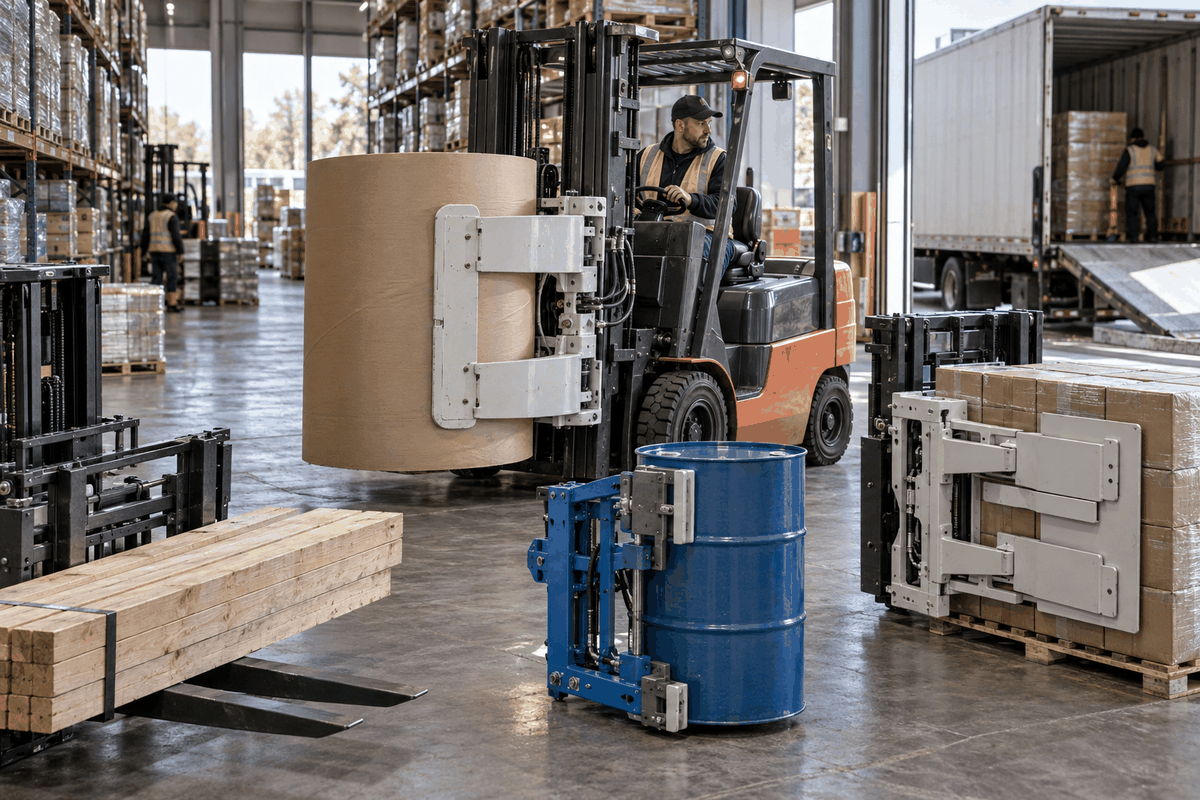
Forklift attachment selection checklist
- Identify actual load types, dimensions, condition, pickup points and daily handling frequency.
- Map the workflow: loading areas, storage locations, trailer access, aisle width and required movements.
- Choose task-specific functions such as side-shifting, rotating, clamping or extended reach.
- Calculate the combined effect of attachment weight, load center and forward load position on capacity.
- Verify compatibility with the forklift model, hydraulic system, mast configuration and visibility requirements.
- Obtain manufacturer approval when modifications affect capacity or safe operation.
- Update capacity markings and train operators on the truck-and-attachment combination’s limits.
When pallet forks Are Enough, and When a forklift attachment Earns Its Place
Standard pallet forks are a practical choice for stable, uniform loads that can be lifted cleanly from a pallet. As load handling demands increase, the right forklift attachment can improve safety, speed, and precision across different types of work.
Forklift Attachments for Specific Tasks: Side Shifter, Fork Positioner and Telescopic Boom Attachment
The right forklift attachments solve a repeatable handling challenge without adding unnecessary complexity. When choosing attachments for forklifts, start with the specific task, load type and work environment. A side shifter allows precise lateral load adjustments without moving the truck, which is useful at tight rack openings and loading docks. A fork positioner lets operators adjust forks from the cab, making it easier to handle changing pallet widths with less manual work. For occasional reach requirements that are clearly defined, a telescopic boom attachment can be one of several practical solutions. These truck attachments should match the forklift model, whether the fleet includes electric forklifts or other material handling equipment.
Other handy forklift attachments are designed for the material being moved. Hydraulic clamps can secure unitized goods that are not carried on a pallet. Bale clamps, drum handlers and other clamps are built around specific load shapes. The different types of forklift attachment can improve load handling when they match the material and intended handling process. Extensions can assist with suitable longer loads, but pallet forks and extensions should be selected as part of the complete truck-and-load arrangement, not as a casual add-on. Choose attachments suitable for the load, ensuring it can be safely supported and be lifted within the truck’s rated limits.
There are easily six well-designed attachment categories to consider, but each attachment adds weight, dimensions and operating limits. Attachment weight can reduce the truck’s lifting capacity and may increase the impact on visibility, stability and the forklift’s center of gravity. Operators need training on the attachment’s controls, limitations and safety requirements. [2][3] Before fitting any of these parts, confirm manufacturer approval and ensure the truck’s capacity markings reflect the attachment combination; OSHA requires this for modifications affecting capacity or safe operation. [1]
Quick Reference: Common Forklift Attachments and Handling Uses
| Attachment category | Typical handling purpose | Operational consideration |
|---|---|---|
| Side shifter | Makes small lateral load adjustments without repositioning the truck; useful at tight rack openings and loading docks. | Adds weight and may affect visibility and the forklift’s center of gravity. |
| Fork positioner | Spaces forks from the cab to accommodate changing pallet widths with less manual adjustment. | Operators need training on operation and limitations. |
| Telescopic boom attachment | Provides occasional reach beyond the carriage for a carefully defined application. | Confirm manufacturer approval and capacity markings for the attachment combination. |
| Hydraulic clamp | Secures unitized goods that are not carried on pallets. | Attachment weight reduces the truck’s lifting capacity. |
| Bale clamp | Handles loads with bale shapes. | Review the attachment’s operating limits and effect on stability. |
| Drum handler | Handles loads with drum shapes. | Review the attachment’s operating limits and effect on visibility. |
| Extensions | May help support a suitable longer load. | Select as part of the complete truck-and-load arrangement, not as a casual add-on. |
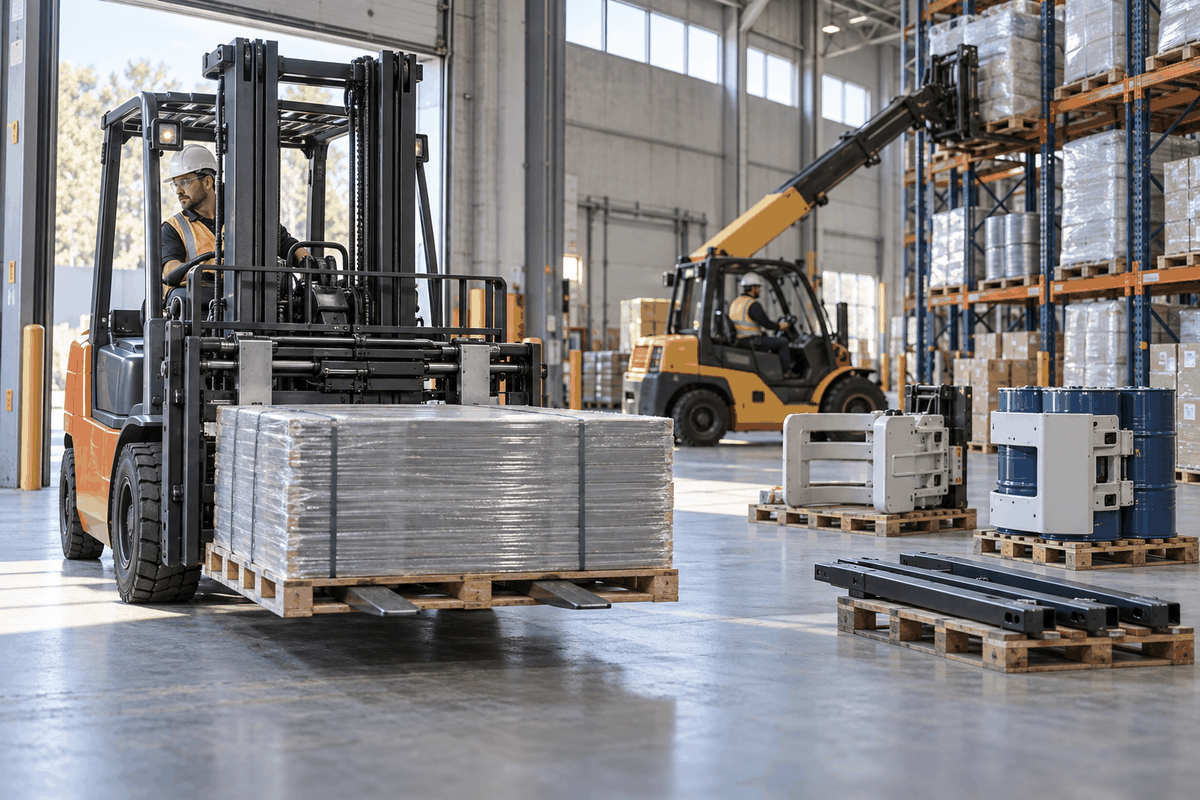
Attachment Selection Checklist
- Match the attachment to a repeatable handling task, not a one-off convenience.
- Use side shifters for precise lateral adjustments at racks, docks, and narrow openings.
- Choose fork positioners when pallet widths change frequently during daily operations.
- Consider telescopic booms only for defined reach requirements and approved load conditions.
- Select clamps, drum handlers, or bale clamps according to the material’s shape and stability.
- Account for attachment weight, reduced capacity, visibility changes, and center-of-gravity effects.
- Confirm manufacturer approval, updated capacity markings, and operator training before use.
Match the Attachment to the Truck: Weight, Capacity and Compatibility
The right forklift attachment can make a truck far more capable, whether the specific task involves shifting loads, handling rolls, clamping cartons or moving unusual material. From pallet forks and extensions to drum handlers, bale clamps, hydraulic clamps and a telescopic boom attachment, different types of forklift attachments support more efficient material handling. The key is choosing attachments for forklifts that suit the load type, the truck model and the work at hand.
Begin with the rated capacity of the complete combination, not the capacity shown for the forklift alone. An attachment adds weight and reduces available lifting capacity. Every load-bearing component, including the carriage, mast, forks and attachment, has its own limit. The data plate for the truck-and-attachment combination cannot exceed the lowest-rated component. [2][4] A 10,000-pound truck is no longer a 10,000-pound truck when a lower-capacity clamp, side shifter, fork positioner or other specialized device is installed.
Load center deserves the same attention. As a load sits farther forward, leverage increases and effective capacity falls. Attachment thickness can move the load forward before the product is even picked up. An off-center, long or irregular load may reduce capacity further. This is especially important for an electric truck, where the configuration and battery weight are central to its engineered balance. Confirm that the intended load can be lifted safely with the selected attachment in place.
Use a manufacturer-approved configuration and insist on a current, legible capacity plate. OSHA requires written manufacturer approval for additions or modifications that affect capacity or safe operation, with instruction plates, tags or decals updated accordingly. [1] For front-end truck attachments that were not factory installed, users must request marking that identifies the attachment and the approximate weight of the truck-and-attachment combination at maximum elevation with a laterally centered load. [1]
Finally, align operator training and daily inspection with the equipment in use. Choose attachments suitable for the load, the application and the available truck capacity. Handy forklift attachments can expand load handling solutions, but their parts, hydraulic connections and mechanical condition require regular attention. These six well-designed considerations help keep forklifts productive while keeping safety at the center of every lift.
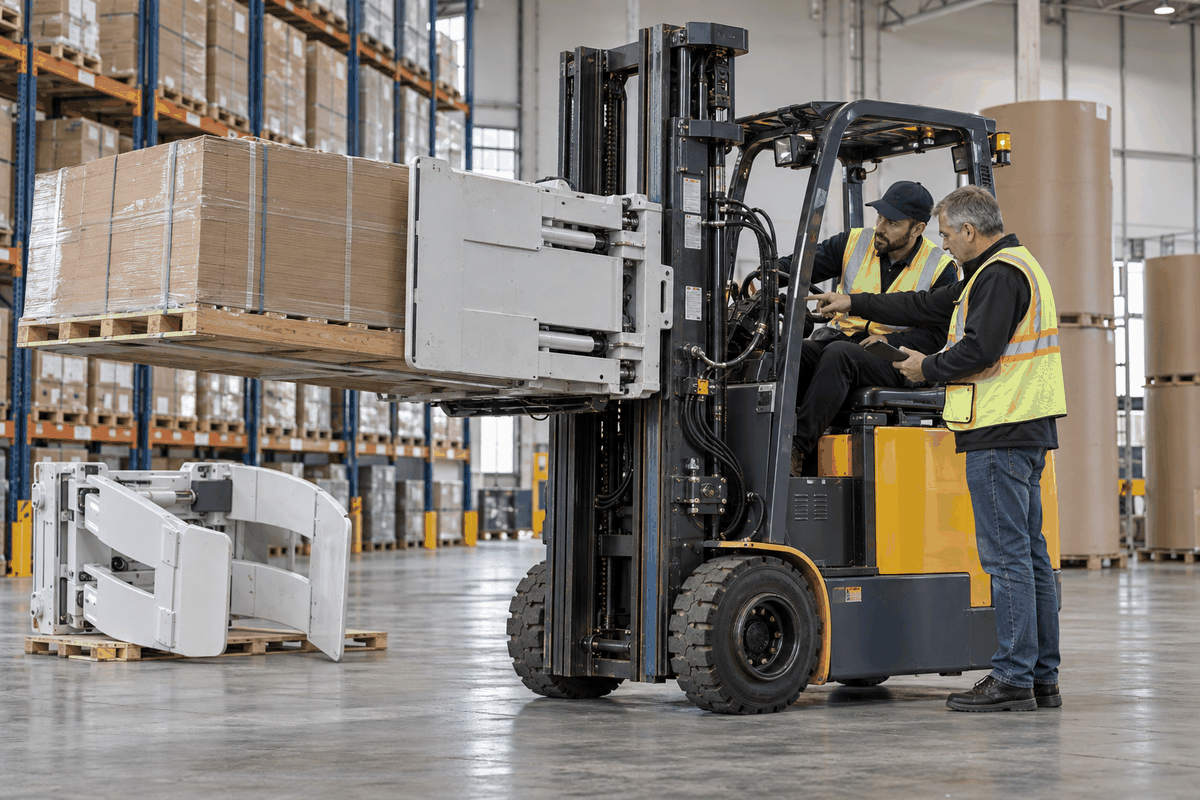
Safety, Inspection and Used-Forklift Checks Before Attachment Work
Before fitting forklift attachments to a used truck, assess the complete combination, not the attachment alone. Added weight, a changed load center and reduced visibility can affect handling, stability and available capacity. An attachment reduces what the forklift can safely lift. Even an unloaded truck carries extra weight once an attachment is fitted. [2]
Start with the truck’s data plate. It should be present, legible and correct for the intended configuration. OSHA requires markings to remain in place and readable. If a front-end attachment was not factory installed, obtain identification marking for the attachment and the approximate truck-and-attachment weight at maximum elevation with a laterally centered load. [1] Capacity depends on the lowest-rated load-bearing component: the forklift, carriage, mast, forks or attachment. It is not simply the truck’s headline capacity. [4]
Inspect forklift attachments with the same care used for forklifts. Check for deformation, cracked welds, worn parts, damaged moving components, and mechanical or hydraulic faults. Follow the manufacturer’s inspection guidance. [2] This applies across different types of truck attachments, including pallet forks, extensions, a side shifter, a fork positioner, drum handlers, bale clamps, hydraulic clamps and a telescopic boom attachment. For clamps, confirm that the contact surfaces and operating mechanisms suit the load type and material being handled. An unsuitable clamp can damage loads long before it creates an obvious operating issue.
Never treat a retrofit as a casual swap. Modifications or additions that affect capacity or safe operation require the manufacturer’s prior written approval. Capacity, operation and maintenance information must then be updated. [1] Operators also need training in the attachment’s limits, vehicle capacity and stability characteristics. [3] When choosing attachments for forklifts, choose attachments suitable for the specific task, the model, the load, and the material handling environment. Whether the truck is electric or combustion-powered, handy forklift attachments should improve load handling rather than increase risk. The six well-designed solutions may include pallet, lifting and handling equipment, but every item must be approved for the truck before it can be lifted or used. For used forklifts, a thorough pre-purchase review of records, safety information and components provides a dependable foundation for attachment work.
Frequently asked questions
How do I choose the right forklift attachment?
Start with the actual load and workflow: its weight, dimensions, shape, condition, pickup method and destination. Then consider required movements such as side shifting, clamping, rotating or extended reach. Choose an attachment designed for a repeatable handling task and verify that it is approved for the specific forklift.
Do forklift attachments reduce lifting capacity?
Yes. The attachment adds weight and often moves the load farther forward, which reduces the forklift’s effective capacity. Capacity is determined by the complete truck, carriage, mast, forks and attachment arrangement; the lowest-rated load-bearing component sets the limit.
When are pallet forks enough?
Standard pallet forks are usually suitable for stable, uniform loads that are properly supported on pallets. An attachment becomes useful when loads require lateral positioning, clamping, rotation, specialized handling or reach that ordinary forks cannot safely provide.
What is a forklift side shifter used for?
A side shifter moves the load laterally without requiring the operator to reposition the entire forklift. It can improve alignment at rack openings, docks and trailers, especially where space is limited or precise placement is needed.
Do forklift attachments need a new capacity plate?
When an attachment affects capacity or safe operation, the forklift must have current, legible markings for the truck-and-attachment combination. OSHA requires prior written manufacturer approval for applicable modifications and updated capacity, operating and maintenance information.
What should be inspected before using a forklift attachment?
Check the data plate, attachment mounting, welds, moving parts, hydraulic hoses and fittings, contact surfaces and controls. Inspect for cracks, deformation, wear, leaks or damage. Confirm the attachment suits the load, and ensure operators understand its capacity, visibility and stability limits.
Can a used forklift safely use a new attachment?
It can, provided the truck is compatible, manufacturer approval is obtained where required, and the capacity plate is updated. Review the used forklift’s mast, carriage, forks, hydraulic system, service records and overall condition before installing the attachment.
References
- Occupational Safety and Health Administration. 1910.178 - Powered industrial trucks. osha.gov
- Occupational Safety and Health Administration. eTool : Powered Industrial Trucks (Forklift) - Parts - Attachments osha.gov
- Occupational Safety and Health Administration. Developing a Training Program for Powered Industrial Truck Operators osha.gov
- Toyota Material Handling. Understanding Forklift Lifting Capacities and Data Plates toyotaforklift.com
- Bolzoni Group. INTEGRATION NOTES ABOUT THE ATTACHMENT AND LIFT TRUCK COMBINATION spareparts.bolzonigroup.com